The Hidden Risks of AI-Developed Scripts: What Businesses Need to Know
Artificial Intelligence is rapidly transforming software development. Organizations are increasingly using AI tools to generate scripts, automate workflows, create integrations, build reports, and accelerate development timelines.
AI-generated code can significantly improve productivity, but businesses must understand one important reality: AI-developed scripts are not always production-ready.
If AI-generated scripts are implemented without proper review, testing, security validation, and governance, they can introduce serious business and technical risks.
This article explains the common challenges associated with AI-developed scripts and outlines practical best practices to reduce risk.
The Growing Popularity of AI-Generated Code
Modern AI coding assistants can generate scripts, integrations, automation routines, formulas, reports, and technical logic within minutes. This has made AI a powerful productivity tool for development teams and business users.
AI-generated code can help organizations:
- Reduce development effort.
- Accelerate project delivery.
- Automate repetitive tasks.
- Support rapid prototyping.
- Improve developer productivity.
- Explore solution ideas faster.
However, speed should not be mistaken for quality, security, reliability, or production readiness.
Common Issues with AI-Developed Scripts
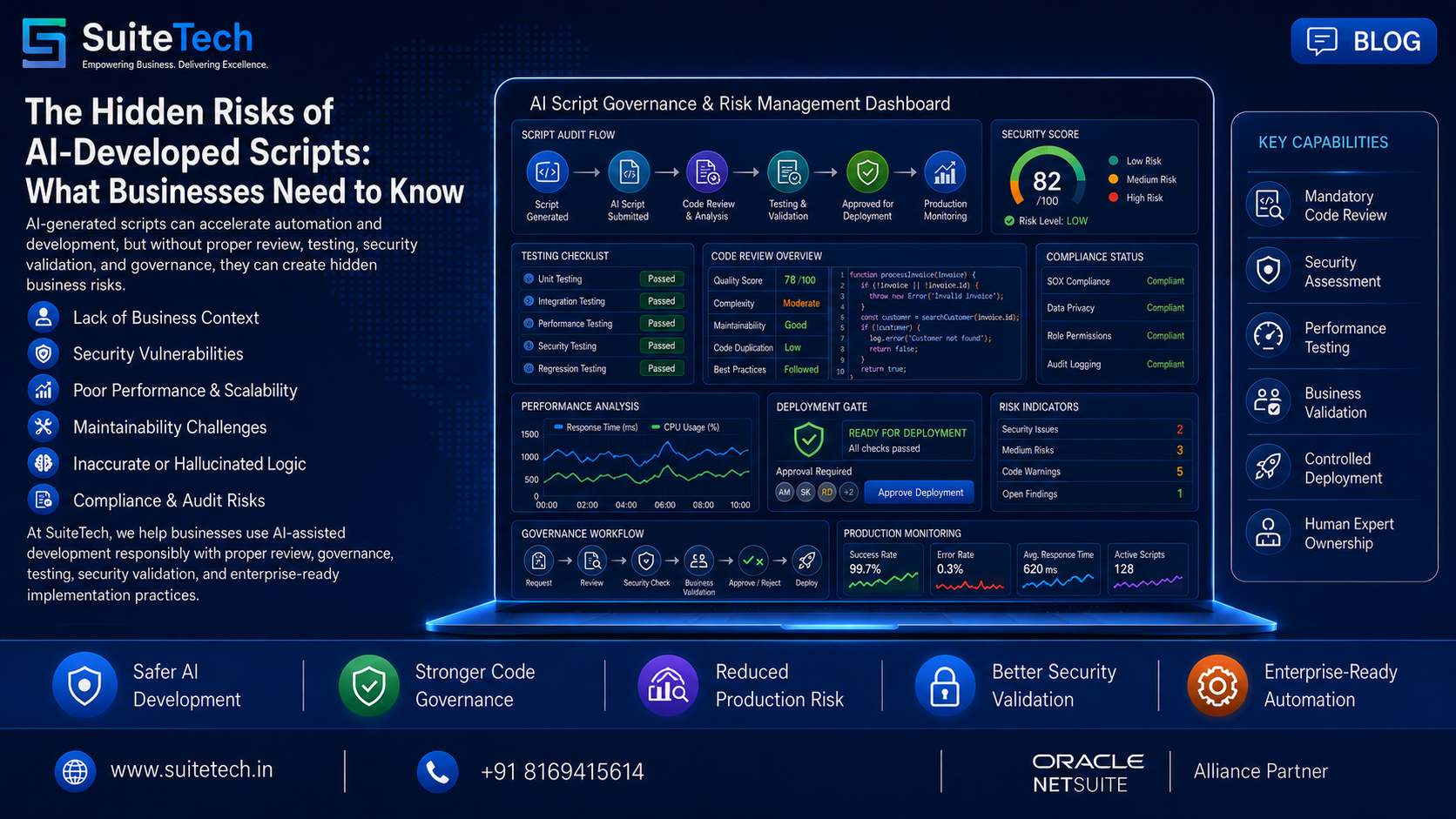
1. Lack of Business Context
AI generates code based on patterns, prompts, and available context. It does not automatically understand the complete business process behind a requirement. As a result, AI-generated scripts may miss important business rules, approval requirements, compliance needs, or industry-specific scenarios.
- Critical business rules may be missed.
- Compliance requirements may be overlooked.
- Industry-specific scenarios may not be considered.
- Edge cases may remain unaddressed.
- The script may technically work but fail to support the real business process.
2. Security Vulnerabilities
AI-generated scripts can unintentionally introduce security risks if they are not carefully reviewed. Common security concerns include:
- Weak authentication mechanisms.
- Improper access controls.
- Exposure of sensitive data.
- Hardcoded credentials or tokens.
- Vulnerabilities to injection attacks.
- Insecure API integrations.
- Missing role-based permission checks.
Without a proper security review, these issues can create significant operational, financial, and compliance risks.
3. Poor Performance and Scalability
AI often focuses on producing functional code, but it may not always generate optimized or scalable logic. A script that works in a small test scenario may fail or slow down in production when transaction volume increases. Common performance issues include:
- Inefficient database queries.
- Excessive API calls.
- Redundant processing logic.
- Memory-intensive operations.
- Poor error handling under high load.
- Limited scalability for large datasets.
4. Maintainability Challenges
AI-generated scripts may work initially but become difficult to maintain later if they lack structure and clarity. Many AI-generated scripts may lack:
- Proper documentation.
- Consistent coding standards.
- Meaningful comments.
- Modular architecture.
- Clear naming conventions.
- Reusable functions.
This creates long-term technical debt and makes it difficult for developers to troubleshoot, enhance, or safely modify the solution in the future.
5. Inaccurate or Hallucinated Logic
AI models may sometimes generate code based on assumptions instead of verified technical requirements. This can result in:
- Incorrect API methods or non-existent functions.
- Invalid syntax patterns.
- Misinterpreted business requirements.
- Incorrect field names or object references.
- Wrong data flow assumptions.
6. Compliance and Audit Concerns
Organizations operating in regulated industries must ensure that every script follows internal governance, audit, and compliance requirements. AI-generated scripts may not automatically align with:
- Financial regulations and data privacy laws.
- Industry standards.
- Internal approval policies and audit trail requirements.
- Data retention rules.
7. Dependency on Prompt Quality
The quality of AI-generated scripts depends heavily on the quality of the prompt and the completeness of the requirement. Poorly defined requirements often lead to:
- Incomplete solutions and incorrect functionality.
- Technical debt and additional rework.
- Wrong assumptions in the generated code.
Real-World Business Impact
Many organizations initially see AI-generated scripts as a shortcut to reduce development time and cost. However, without proper validation, the hidden cost can be much higher. Poorly reviewed AI-generated code may lead to:
- Production incidents and system performance degradation.
- Data integrity issues and security breaches.
- Incorrect business outputs and increased support costs.
- Delayed project timelines due to rework.
In some cases, the effort required to fix poorly generated code can exceed the time saved during initial development.
Best Practices for Using AI in Development
AI should be treated as a productivity accelerator, not a replacement for experienced developers, architects, testers, and business analysts.
- Mandatory Code Reviews: All AI-generated code should go through proper peer review before deployment. Developers should validate logic, structure, security, performance, and maintainability.
- Security Assessment: Every AI-developed script should be reviewed for authentication, authorization, sensitive data exposure, API security, input validation, and access control.
- Performance Testing: Scripts should be tested under realistic workloads to confirm that they can handle production-level transaction volume, API calls, and data processing.
- Business Validation: Business users and process owners should confirm that the script meets real business requirements, not just technical expectations.
- Documentation Standards: Maintain proper technical and functional documentation, including purpose, data flow, dependencies, assumptions, limitations, and support instructions.
- Governance Framework: Organizations should define clear policies for how AI-generated code can be used, reviewed, approved, tested, and deployed.
- Controlled Deployment: AI-generated scripts should be tested in sandbox or staging environments before moving into production.
- Human Expertise and Ownership: A qualified developer or technical owner should always take responsibility for reviewing, validating, and maintaining AI-generated scripts.
Final Thoughts: AI and Human Developers Should Work Together
The future of software development is not AI versus humans. It is AI and humans working together. AI can help generate ideas, reduce repetitive effort, speed up prototyping, and assist with development tasks. Human experts are still required to understand business context, validate architecture, check security, optimize performance, and ensure long-term maintainability.
AI is revolutionizing software development and can deliver significant efficiency gains when used correctly. However, AI-developed scripts should never bypass standard software engineering practices. Successful organizations combine the speed of AI with human expertise, governance, testing, and business validation.
By treating AI as a powerful assistant rather than an autonomous developer, businesses can maximize innovation while minimizing risk. The best approach is clear: use AI to accelerate development, but rely on skilled professionals to validate, secure, optimize, and govern the final solution.