NetSuite Bill Capture vs AI-Based Bill Creation: A Small Difference with a Big Business Impact
Every finance team using NetSuite eventually hits a wall with manual data entry. To scale operations without linearly scaling headcount, modern finance teams turn to Accounts Payable Automation. However, when evaluating your options within the NetSuite ecosystem, you will quickly encounter two distinct approaches: standard NetSuite Bill Capture and advanced AI-Based Bill Creation.
While both solutions aim to eliminate manual typing and streamline vendor bill processing, they solve fundamentally different levels of AP complexity. Understanding this difference is critical to selecting a NetSuite Finance Automation strategy that actually transforms your accounting workflows.
What is NetSuite Bill Capture? (The OCR Baseline)
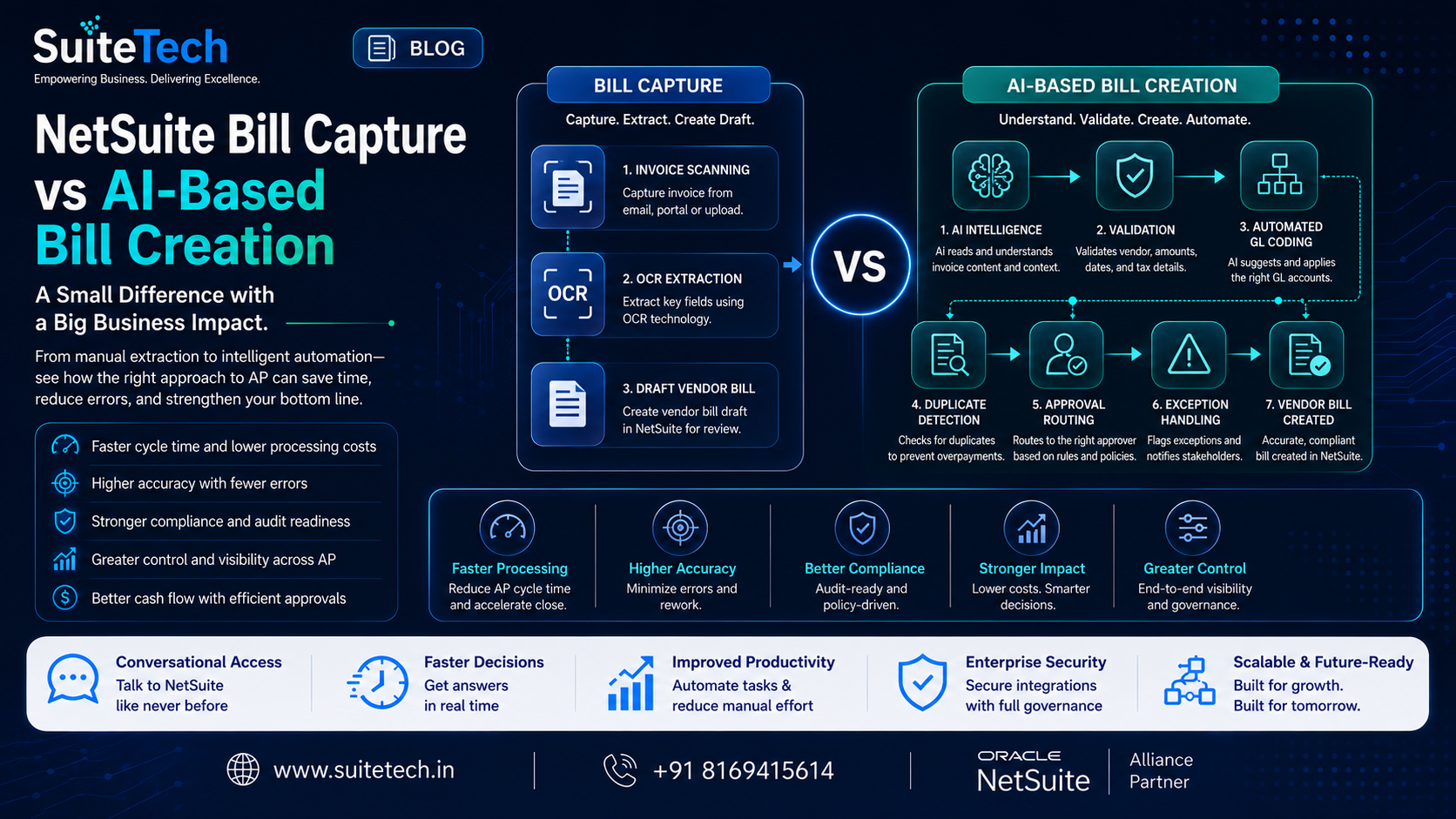
Standard NetSuite Bill Capture relies primarily on traditional NetSuite OCR (Optical Character Recognition) technology. It essentially serves as a digital scanner that reads an uploaded or emailed invoice, identifies standard template-based fields (such as invoice number, date, and total amount), and populates a draft vendor bill record in NetSuite.
Key Features of NetSuite Bill Capture:
- Speeds Up Header Entry: Eliminates the need to manually type basic header-level data for straightforward invoices.
- Centralizes Documentation: Keeps the source PDF attached directly to the NetSuite transaction for auditing purposes.
- Native Tooling: It is a built-in feature that helps growing teams take their first basic step away from entirely manual data entry.
Limitations for Growing Businesses:
Traditional OCR is rigid. If a vendor changes their invoice layout, or if a scanned document is slightly blurry, standard OCR often fails or extracts data incorrectly. More importantly, it generally requires significant human intervention for detailed line-item mapping, General Ledger (GL) coding, and manual routing for approvals. It digitizes the text, but it doesn't truly understand the context of your accounting rules.
What is AI-Based Bill Creation? (The Intelligent Engine)
AI-Based Bill Creation moves far beyond simple text extraction. Next-generation AI Invoice Processing solutions use machine learning and contextual intelligence to understand the deeper context of the invoice, historical billing patterns, and your company's specific multi-subsidiary accounting environment.
Instead of just mapping text to a rigid field, an Intelligent Invoice Processing system acts like an experienced, digital AP clerk that continuously learns.
Advanced Capabilities of AI-Driven Systems:
- Predictive GL Coding: The AI learns from your historical books and automatically suggests the correct GL accounts, departments, classes, or custom segments for specific line items—no manual coding required.
- Automated 3-Way Matching: It automatically reconciles the incoming invoice against the NetSuite Purchase Order (PO) and Item Receipt, seamlessly handling complex unit-of-measure conversions and instantly flagging variances.
- Advanced Duplicate Detection: Traditional tools only look for exact string matches. AI uses fuzzy matching to catch duplicate bills even if an invoice number was mistyped (e.g., INV-001 vs. INV001) or if a vendor submits the same charge under a slightly altered date.
- Dynamic Exception Management: Instead of forcing a human to review every clean invoice, the AI processes straight-through bills automatically and only routes true anomalies or discrepancies to your team for approval.
Feature Comparison: OCR vs. AI Invoice Processing
When mapping out your AP Transformation roadmap, seeing these capabilities side-by-side clarifies which tool matches your transactional volume:
| Feature | NetSuite Bill Capture (OCR) | AI-Based Bill Creation |
|---|---|---|
| Core Technology | Optical Character Recognition (Template-based) | Machine Learning & LLMs (Context-aware) |
| Data Extraction Scope | Primarily header-level; rigid field mapping | Header & deep line-level item extraction |
| GL & Segment Coding | Manual entry or basic default rules required | Predictive automation based on historical data |
| PO Matching Capabilities | Basic or manual linking to POs | Automated 2-way and 3-way matching with variance triggers |
| Duplicate Checking | Flags exact invoice number matches only | Multi-variable fuzzy match anomaly detection |
| Ideal Operational Scale | Low invoice volume, single subsidiary, simple bills | High volume, complex line items, multi-subsidiary |
The Strategic Impact on Your Bottom Line
Moving from standard text capture to a fully automated Vendor Bill Automation system yields massive operational advantages for scaling enterprise finance teams:
- True Exception-Based Management: Basic bill capture often shifts your team's role from "data enterers" to "data correctors." True AI-driven automation minimizes human touchpoints entirely, allowing your AP staff to focus solely on resolving high-level exceptions.
- Accelerated Month-End Close: Predictive GL coding and automated matching mean bills don't sit stagnant in an email thread waiting for department classification. Real-time processing accelerates accruals and significantly shortens the close cycle.
- Proactive Risk Mitigation: Advanced duplicate detection and strict automated matching prevent overpayments, vendor billing fraud, and compliance discrepancies that basic scanners easily miss.
Which Solution Fits Your Business?
If you run a compact operation with low monthly invoice volume, straightforward line items, and a single, static chart of accounts, standard NetSuite Bill Capture is an excellent stepping stone to eliminate paper-based typing.
However, if your organization is scaling rapidly, navigating hundreds or thousands of complex vendor bills monthly, managing multiple subsidiaries, or struggling with manual PO matching bottlenecks, traditional OCR will leave gaps. Investing in a robust AI-Based Bill Creation workflow is the definitive step required to unlock complete, hands-free NetSuite AP Automation and future-proof your financial operations.